
First Trip to Tokyo Guide [2026 Edition] — Classic Spots, a One-Day Itinerary, and Your Budget
Your first trip to Tokyo brings excitement — and the honest worry of not knowing what to prepare. This guide covers the classic spots and a one-day itinerary first, then the essentials a first-time visitor should know, from pre-departure prep to how to handle things on the ground.
Before You Depart
The preparations that make a trip comfortable are the ones you cannot make after landing. Get these ready before you fly.
- Passport and stay schedule: Japan requires remaining validity on your passport. Many countries enjoy visa-free short stays, but check the rules for yours in advance
- A data connection: eSIM, rental Wi-Fi, or a local SIM. Maps, translation, and route search all assume you are online
- A transit IC card: Suica and similar cards can be added to your smartphone for smooth station gates
- Some cash exchanged: Credit cards and QR payments are widespread, but small shops and shrines may still be cash-only
From the Airport to the City
Tokyo has two main airports.
- Haneda: close to the city center — about 30 minutes by train to major areas
- Narita: about 60–90 minutes by train, with express and commuter options
If you arrive late, watch the last train times; missing them means considering a hotel near the airport.
Getting Around the City
Public transport in Tokyo is train-first.
- Tap your IC card at the gate: no paper tickets needed — tap in and tap out
- Think in terms of the Yamanote Line and the Metro: the Yamanote Line loops around the center. Combined with the subway (Tokyo Metro and Toei), it reaches almost everywhere
- Avoid rush hour: weekday mornings (roughly 7:30–9:00) and evenings (roughly 17:00–19:00) get extremely crowded. With big luggage, shifting your schedule is wise
Route and map apps are essential. Travel time depends more on the number of transfers than on distance as the crow flies.
Classic Spots for First-Timers
Tokyo is big enough that deciding where to go is itself the hard part. Start with the five essentials below, one per area.
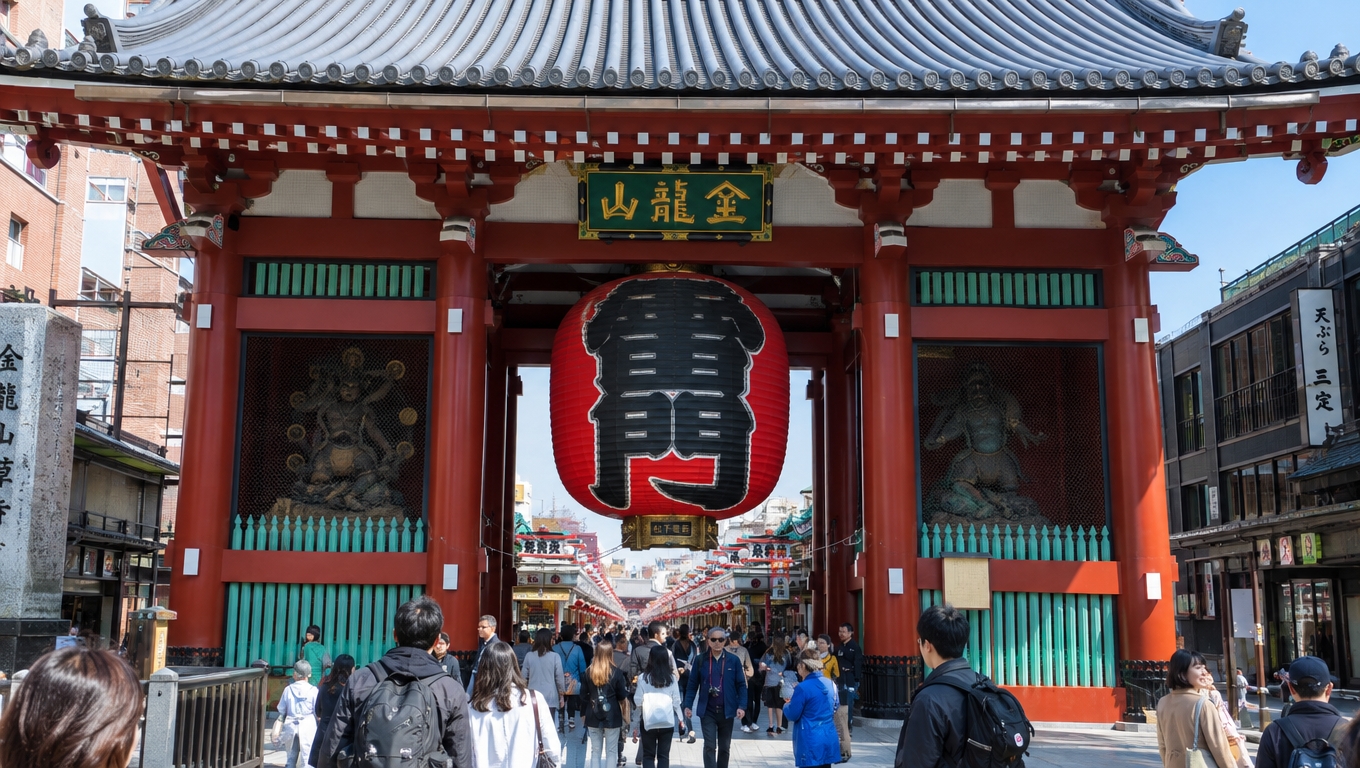
- Asakusa and Sensoji Temple: Walk from Kaminarimon through Nakamise street to the main hall. One of Tokyo's most historic downtown scenes — and quietest in the early morning
- Tokyo Skytree: One station by train from Asakusa, in Oshiage. Pair the observation deck with lunch in the Solamachi mall at its base
- Meiji Shrine, Harajuku, and Omotesando: A forest shrine walk in the middle of the city, young-culture Harajuku, and stylish Omotesando — all within walking distance of each other
- Shibuya: The scramble crossing and Center-gai. The neon really comes alive from late afternoon into the evening
- Tokyo Station and Marunouchi: The red-brick station building, ekiben boxed lunches, and the Marunouchi skyscrapers. Easy to slot into your itinerary as the hub for shinkansen or airport access
With extra time, the food at Tsukiji Outer Market and the museums and zoo of Ueno Park are classic second-day options.
A One-Day Itinerary for Beginners
Once you know how to get around, the classic spots fit into a single day. This beginner course rides trains the whole way. Start with the quick-pick table.
| Days | Plan | Best for |
|---|---|---|
| 1 day | Loop all five classic areas | Fewest transfers, most efficient |
| 2 days | East side day 1, west side day 2 | Relaxed and fatigue-free |
| 3 days | 2 days + Tsukiji, Ginza, Marunouchi | Food and shopping included |
One-day course (timeline):
- 9:00 Asakusa — Visit Sensoji and grab a snack on Nakamise before the crowds build
- 11:30 Tokyo Skytree — One station from Asakusa. Deck views, then lunch at Solamachi
- 14:30 Meiji Shrine and Harajuku — Walk the forest approach from Harajuku Station, then wander toward Omotesando
- 17:30 Shibuya — Cross the scramble and watch the city light up at dusk
- 19:30 Shinjuku or Tokyo Station — Night views and dinner. Pick whichever fits the next day's travel
The course uses only the Yamanote Line and the subway, so it suits days with light luggage. On museum or shopping days, drop Shibuya or Harajuku to make room.
Per-leg transit guide:
- Asakusa → Tokyo Skytree: Tobu Skytree Line, one stop (about 5 min)
- Tokyo Skytree (Oshiage) → Harajuku: Hanzomon Line to Shibuya (about 25 min), then one stop on the Yamanote Line
- Shibuya → Shinjuku: Yamanote Line, about 7 min
If a ticket machine confuses you, snap the screen first and check it later at your own pace.
Variations on the one-day course (swap to taste):
- Tower person: swap Tokyo Skytree for Tokyo Tower (head to Roppongi/Azabu in the afternoon; Oedo Line to Akabanebashi)
- Museums and shopping: drop Shibuya for the Omotesando museums and Ginza
- Rainy day: build the day indoors — Skytree deck and Solamachi, plus Shibuya's malls
If you have two days: east on day 1, west on day 2
- Day 1 (east): Asakusa → Tokyo Skytree → Ueno Park and Ameyoko → evening around Asakusa or Ueno
- Day 2 (west): Meiji Shrine and Harajuku → Omotesando → Shibuya → Shinjuku night views to finish
Splitting the city east–west cuts train time dramatically. For a first visit, this two-day plan is the least tiring shape.
If you have three days: add food and Marunouchi on day 3
- Day 3: Tsukiji Outer Market (breakfast) → stroll Ginza → Tokyo Station and Marunouchi (station building, ekiben, souvenirs)
Day 3 is for food and shopping. If your shinkansen or airport access leaves from Tokyo Station, it slots straight into the end of the trip.
Food Basics
Once you understand how ordering works, eating in Tokyo is pure joy.
- Meal ticket system: popular ramen shops and others have you buy a ticket from a machine at the entrance first
- Touch-panel ordering: more restaurants let you order from a screen at your seat
- Point-and-order: where menus have photos, pointing just works
- No tipping: tipping is not customary in Japan
- Payment: card and QR payment acceptance is broad, but there are still places where cash is safer
Manners Worth Knowing
A few basics will keep your stay pleasant for you and everyone around you.
| Situation | Manners |
|---|---|
| Escalators | Stand on one side and keep the other clear (the side varies by region) |
| On trains | Avoid phone calls and loud conversation |
| Smoking while walking | Prohibited or penalized in most areas |
| Trash | Public bins are scarce — take garbage with you |
| Queues | Line up at stations and shops. Never cut in |
First Trip to Tokyo: FAQ
How many days do I need for Tokyo?
Two days cover the classic spots; three lets you take them at ease. A clean split is day one on the east side (Asakusa, Skytree) and day two on the west side of the Yamanote Line (Meiji Shrine, Harajuku, Shibuya), which keeps transfers to a minimum.
How much does a day in Tokyo cost?
Excluding lodging, a reasonable daily budget is ¥1,000–1,500 for transit, ¥3,000–5,000 for food, and ¥2,000–3,000 for sights and entry fees — roughly ¥6,000–10,000 per day. Paid decks and observatories push it higher.
Is Tokyo good for solo travelers?
Very. Counter-seat ramen shops and restaurants with single-seat tables are common, and frequent trains keep your schedule flexible. Avoiding peak hours makes Tokyo one of the easier cities for a first solo trip.
When is the best season to visit Tokyo?
Late March to early April for cherry blossoms, and late October to early December for autumn foliage, offer the most to see (Tokyo's blossoms peaked on March 28 in 2026). Summer (July–August) is humid, and Golden Week, Obon, and the New Year holidays get crowded with domestic travelers — shifting your dates makes everything smoother.
Can I get by without Japanese?
Major stations signpost in English, Chinese, and Korean, and more tourist-area restaurants have English menus. Ticket machines and small-shop menus still catch you out, though — which is exactly where a tool that explains what you photographed earns its place.
When Confused, Snap First
Most Tokyo frustrations come down to reading Japanese displays and knowing what to do. The first move is always the same: take a photo. You can translate it, or check it later at your own pace.
- Snap the ticket machine screen, and confirm which ticket to buy without rushing
- Snap a Japanese menu, and translate it — or get an AI explanation of the dishes
- Snap a sign, and check how to enter or where to go next afterwards
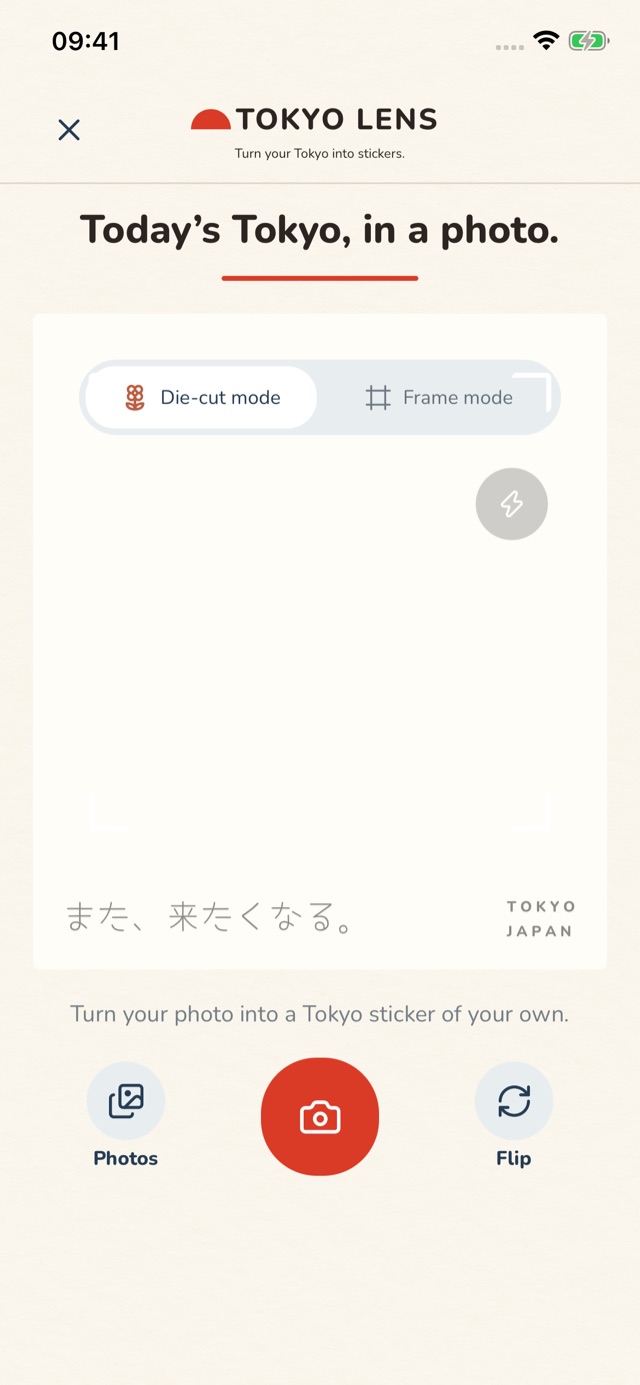
TOKYO LENS is a Tokyo travel camera that cuts what you photograph into a die-cut sticker on the spot and keeps it in your travel journal and map. Anything you save is explained by AI in 8 languages, with read-aloud and next-spot suggestions (5 explanations a day free). The photo from a confusing moment becomes a memory of the trip.
For how to turn your photos into a travelogue, see How to Keep Your Tokyo Travel Memories: Shoot, Cut Out, and Paste into a Travel Journal.
Summary
What a first trip to Tokyo really requires is not a perfect plan — it is knowing how to solve problems when they appear. Sketch your route with the classic spots and the one-day itinerary, cover the basics of prep, transit, food, and manners, keep the snap-first habit for everything else, and let TOKYO LENS turn every photo you take into a record of your trip.